Lawfare Against Journalism Project Receives Institutional Support from ABRAJI

The Lawfare Against Journalism project has received institutional support from the Brazilian Association of Investigative Journalism (ABRAJI), one of the leading organisations dedicated to promoting investigative journalism, press freedom, transparency, and access to information in Brazil. The support reinforces the project’s commitment to documenting and analysing legal strategies used to intimidate, silence, or constrain journalists and news organisations, while strengthening dialogue with professional and advocacy networks working to defend journalism in increasingly challenging democratic environments. Founded in 2002, ABRAJI is a non-profit organisation created by journalists to improve the quality of journalism, promote professional training, defend freedom of expression, and advance the right of access to public information. Throughout its history, the association has become a reference in investigative journalism, organising congresses, seminars, workshops, training programmes, and projects dedicated to journalism safety, transparency, and accountability. The institutional support from ABRAJI is particularly significant given the growing relevance of discussions on lawfare, judicial harassment, strategic lawsuits against public participation (SLAPPs), and other forms of legal pressure targeting journalists and media organisations worldwide. The Lawfare Against Journalism project seeks to map and analyse these practices internationally, examining how legal mechanisms can be instrumentalised to undermine public-interest reporting, restrict freedom of expression, and weaken democratic accountability. The collaboration also reflects shared concerns regarding journalism safety and the protection of fundamental democratic rights. Over the years, ABRAJI has developed initiatives focused on access to information, monitoring threats against journalists, promoting investigative reporting, and strengthening professional networks dedicated to defending press freedom. The association’s longstanding work has helped position these issues at the centre of public and policy debates in Brazil and beyond. For the project’s Principal Investigator, Lucia Monteiro Mesquita, the support also carries a personal and professional significance. Mesquita has been an ABRAJI member (“associada”) since 2016, participating in the association’s community of journalists and researchers committed to investigative reporting, professional development, and the defence of democratic values. This institutional support, therefore, represents not only a collaboration between organisations but also the continuation of a longstanding connection with one of Brazil’s most influential journalism associations. As the project advances, the partnership is expected to contribute to broader discussions on journalism safety, legal intimidation, freedom of expression, and the future of investigative reporting in digital and platformised societies. It also creates opportunities for future exchanges between researchers, journalists, and advocacy organisations working at the intersection of journalism, law, democracy, and human rights. More information about the Lawfare Against Journalism project is available at Lawfare Against Journalism Project. Further information about ABRAJI can be found on the ABRAJI – Brazilian Association of Investigative Journalism website. Declaration of Generative AI Use Generative AI tools were used during the drafting and editing process of this news piece to support text organisation, language refinement, and stylistic revision. The author reviewed, edited, and verified all content, references, and factual information prior to publication and retains full responsibility for the final version.
Lawfare Against Journalism Project Receives Institutional Support from Young AI Leaders Lausanne Hub
The Lawfare Against Journalism project is receiving institutional support from the Young AI Leaders Lausanne Hub, a local chapter of the Young AI Leaders Community, an initiative developed under the International Telecommunication Union’s (ITU) AI for Good platform. This collaboration strengthens the project’s international dimension by contributing applied artificial intelligence expertise to its research activities, while also highlighting the growing relevance of journalism safety, freedom of expression, and access to information within broader discussions on technology, democracy, and sustainable development. AI for Good was established by the ITU, the United Nations agency for digital technologies, to advance the use of artificial intelligence in support of the United Nations Sustainable Development Goals (SDGs). Through its global network of Young AI Leaders hubs, the initiative supports youth-led projects that promote responsible innovation, ethical AI development, and social impact. The Young AI Leaders Community currently brings together hubs and members from dozens of countries, fostering international collaboration around AI-related challenges and opportunities. The support from the Lausanne Hub emerges from a shared commitment to addressing democratic challenges in increasingly digital and platformised societies. The Lawfare Against Journalism project investigates the use of legal mechanisms, strategic litigation, and judicial harassment as tools to silence journalists, news organisations, and public-interest reporting. By documenting and analysing these practices globally, the project seeks to help protect press freedom and strengthen democratic institutions. The collaboration is particularly relevant in light of Sustainable Development Goal 16, which promotes peaceful, just, and inclusive societies and explicitly highlights the importance of ensuring public access to information and protecting fundamental freedoms. The project’s objectives directly intersect with these priorities by examining contemporary threats to journalism and the public’s right to information. As part of the Young AI Leaders Community, the Lausanne Hub develops and supports initiatives that explore how emerging technologies can help address global challenges through local and international action. The collaboration with the Lawfare Against Journalism project reflects a conviction in a multidisciplinary approach, in which artificial intelligence techniques for media analysis, together with the expertise of journalists and media scholars, can help achieve a better-informed society. Beyond technical support by the Hub Leader of Lausanne Hub David Alonso del Barrio, the collaboration also creates opportunities for future dissemination and public engagement. Research outputs emerging from the project may be shared through AI for Good and Young AI Leaders communication channels, helping connect discussions on journalism safety and lawfare to broader international conversations about technology, governance, and sustainable development. With a global network of hubs and a large international audience, the initiative provides an important platform for amplifying research and fostering interdisciplinary dialogue on these issues. More information about the Lawfare Against Journalism project is available at Lawfare Against Journalism Project. Further information about the Young AI Leaders Community and the Lausanne Hub can be found at AI for Good – Young AI Leaders Community and Young AI Leaders- Lausanne Hub. Declaration of Generative AI Use Generative AI tools were used during the drafting and editing process of this news piece to support text organisation, language refinement, and stylistic revision. The author reviewed, edited, and verified all content, references, and factual information prior to publication and retains full responsibility for the final version.
The launch of the Lawfare Against Journalism Project at the 20th International Journalism Festival
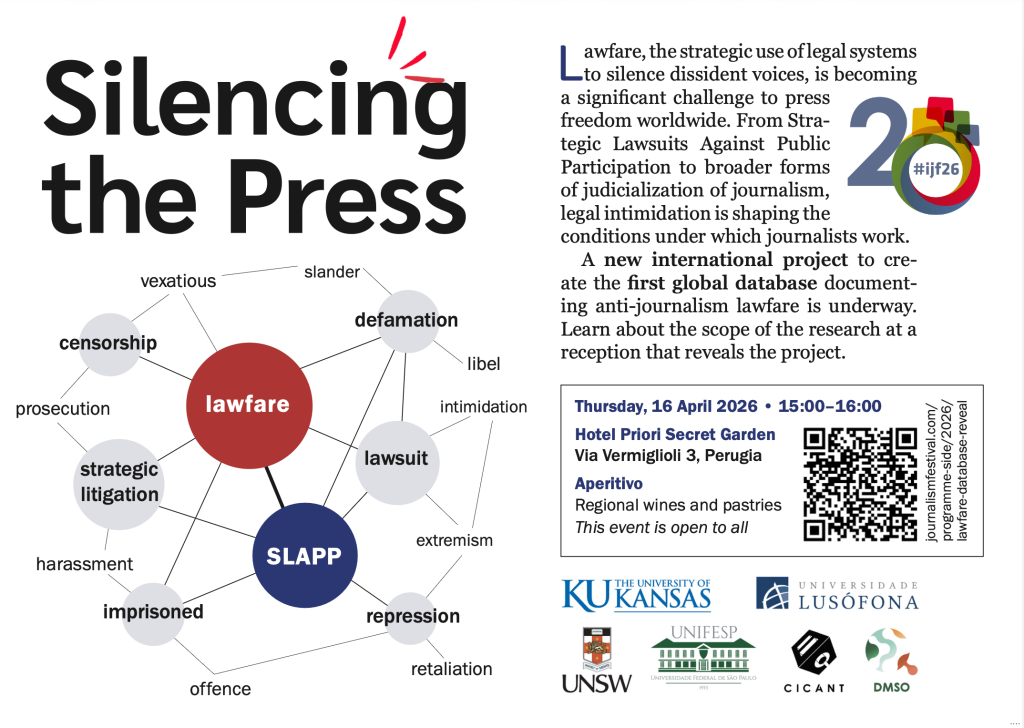
On 16 April 2026, researchers, journalists, and media scholars gathered in Perugia, Italy, during the 20th edition of the International Journalism Festival, for the event “Lawfare database reveal.” Held at the Hotel Priori Secret Garden, the session marked the public introduction of our project, the Lawfare Against Journalism, an international interdisciplinary research initiative, which is building the first systematic database of lawfare cases against journalists worldwide — bringing computational social science methods to bear on a problem that has, until now, resisted systematic study. The session brought together an international team of researchers leading the project: Lucia Mesquita (Lusófona University, Portugal), Mathias Felipe de Lima Santos (University of New South Wales, Australia), and Stephen Wolgast (University of Kansas, USA). Also, the session was joined by Charlie Holt, who leads the European work of Global Climate Legal Defense (CliDef), an organization set up to support climate activists facing SLAPPs and other legal threats Participants were introduced to the project’s scope and methodology, followed by an open discussion inviting attendees to share examples, insights, and potential collaborations. Organized by the School of Journalism at the University of Kansas, the session concluded with an informal networking session over refreshments, celebrating the project’s official launch and encouraging continued engagement from the global journalism community. The lawfare database project is currently in its initial phase and welcomes contributions from journalists, researchers, and organizations interested in documenting and combating the judicialization of journalism.
Lawfare Against Journalism project participates in SLAPP Resilience Roundtable in São Paulo
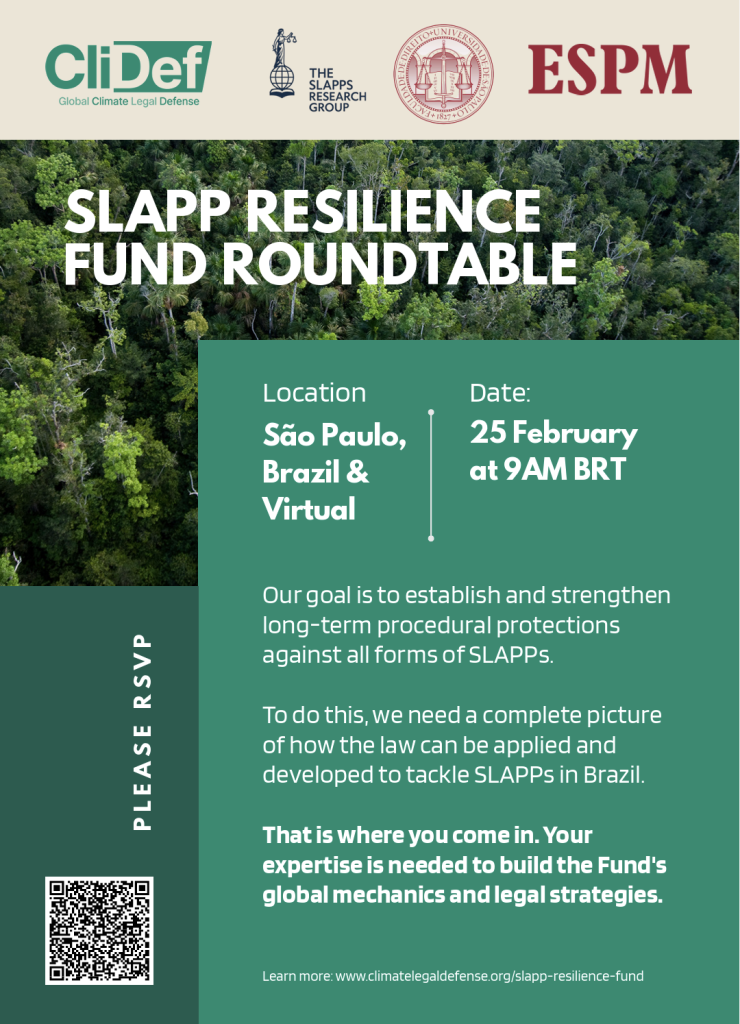
The Lawfare Against Journalism project took part in the SLAPP Resilience Roundtable, held on 25 February 2026 at the Escola Superior de Propaganda e Marketing (ESPM) in São Paulo, Brazil. Organized by Global Climate Legal Defense (CliDef), the roundtable brought together an international network of researchers, legal experts, and civil society actors to discuss strategic responses to Strategic Lawsuits Against Public Participation (SLAPPs). The event marked an important opportunity for the Lawfare Against Journalism project to engage with ongoing global efforts to address legal intimidation and its broader implications. Discussions focused on the development of the SLAPP Resilience Fund, a new initiative aimed at strengthening long-term procedural protections, supporting legal strategies, and fostering accountability in cases of abusive litigation. Throughout the day-long roundtable, participants contributed their expertise to map how SLAPPs and related legal mechanisms are shaping legal systems and impacting fundamental rights such as freedom of expression and assembly. The open and collaborative format encouraged in-depth exchange on legal strategies, comparative perspectives, and the need for coordinated international responses. The participation of the Lawfare Against Journalism project contributed to the growing importance of understanding SLAPPs within a broader framework of lawfare against journalists and media organizations. The discussions also highlighted the need for comprehensive data and cross-sector collaboration — key priorities aligned with the project’s ongoing work. This engagement represents a further step toward positioning the project within international networks addressing legal threats to public-interest actors, while contributing to the development of strategies to counter the growing use of lawfare worldwide.
Lawfare Against Journalism project presented at the Future of Journalism Conference

The Lawfare Against Journalism project was presented at the Future of Journalism Conference, held on 11–12 September 2025 at Cardiff University. The conference, hosted by the School of Journalism, Media and Culture (JOMEC), is one of the most established academic events in journalism studies in Europe, bringing together scholars from across the globe. Lucia Mesquita presented the study “Silencing the Press: Lawfare as a Tool Against Press Freedom,” marking the first academic presentation of the Lawfare Against Journalism project. The presentation introduced the project’s conceptual framework, which examines how legal systems are increasingly used to constrain journalism. Moving beyond a narrow focus on Strategic Lawsuits Against Public Participation (SLAPPs), the research advances the concept of systemic lawfare to capture a broader set of legal mechanisms — civil, criminal, and administrative — that are strategically mobilized to silence or deter journalistic work. The paper highlighted how these practices operate across different political contexts, from democratic to authoritarian settings, and contribute to what can be understood as a “judicialization of control.” By framing journalism as a form of social harm through legal narratives related to reputation, security, or morality, these mechanisms generate chilling effects that extend beyond individual cases. The presentation also outlined the project’s empirical approach, which combines media analysis, legal and policy document review, and interdisciplinary scholarship to map and understand the growing use of lawfare against journalists worldwide. This first academic presentation represents an important step in consolidating the project’s research agenda and engaging with the international scholarly community on the challenges facing press freedom today.