Lawfare Amid Democratic Decline: Speaking at the ICA Pre-Conference on Platforms, Power, and Contested Communication
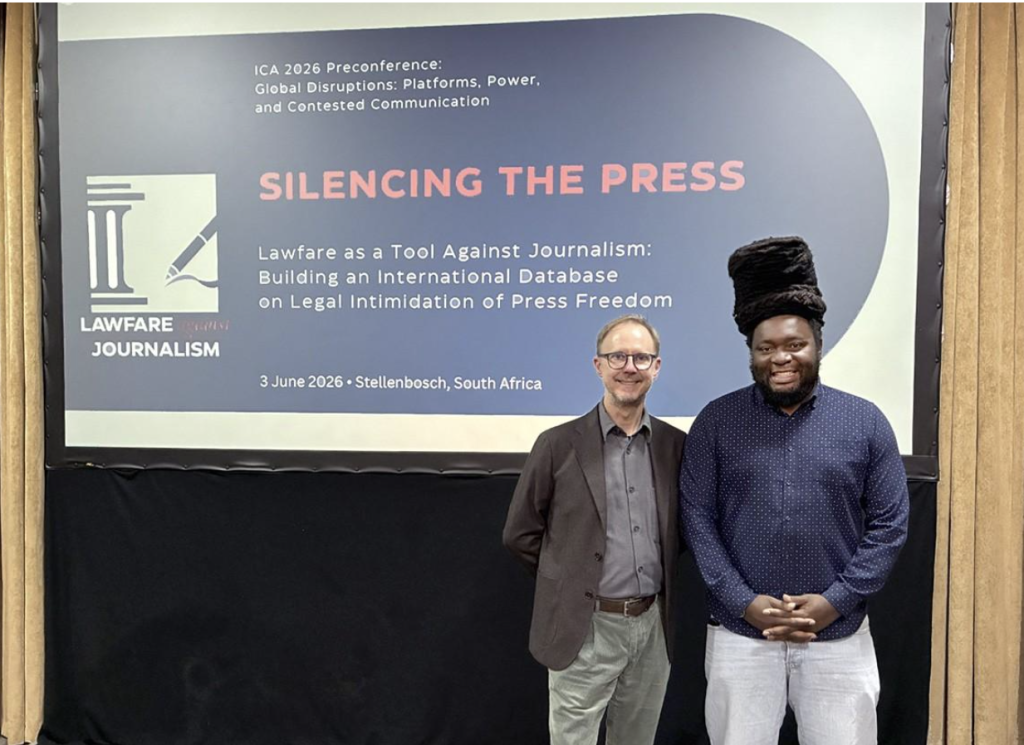
Stephen Wolgast We spread the word about our work into lawfare at the preconference of the International Communication Association in June. Speaking in Stellenbosch, South Africa, I spoke in a session of about thirty participants describing our goals. The paper, by Lucia Mesquita as the lead author and co-written by Mathias Felipe de Lima Santos, Bruce Mutsvairo, Janara Nicoletti and me, explained how legal mechanisms undermine journalism’s democratic role. In the session on platforming democratic decline, it was one of six papers, leaving each presenter with eight minutes. Despite the brief time in front of the audience, our paper was well received, with a couple of questions about our scope (currently examining Europe, Russia, Latin America and the U.S.) and the timeframe (posting results in 2027). One of the paper’s co-authors, Bruce Mutsvairo, was in the audience and posed with me after the questions.
When the Law Becomes the Weapon: How Lawfare Is Silencing Journalism Worldwide
At the International Journalism Festival in Perugia this April, artificial intelligence consumed much of the air in many of the rooms during the event’s twentieth annual gathering. Yet, across the sessions focused on press safety, a different, less visible threat kept pushing its way into the conversation. One of the speakers, Maria Ressa, the Nobel Peace Prize laureate and co-founder of Philippine news outlet Rappler, gave it its sharpest name: “death by a thousand cuts.” She was not speaking metaphorically. She was describing five tax evasion cases, eleven arrest warrants in a little over a year, two arrests in six weeks, a company that could not open a bank account, $1.5 million spent on legal costs in a single year, and the experience of being questioned at Australian customs — on arrival and on departure — for offenses she has always denied. “I work-flowed it,” she said, with the weary precision of someone who has had to treat their own persecution as a project management problem. What Ressa was describing has a name in legal and advocacy circles: lawfare. And it is moving rapidly from those circles into the mainstream of journalism discourse. Beyond SLAPPs: what lawfare actually means Most journalists and press freedom advocates are now familiar with SLAPPs — Strategic Lawsuits Against Public Participation — the use of expensive litigation to silence critics and exhaust their resources. Awareness has grown to the point that the European Union adopted its Anti-SLAPP Directive in April 2024, and similar efforts are underway across national legislatures. But lawfare is a considerably broader problem — and a considerably harder one to see. While a SLAPP is a lawsuit, lawfare is a hidden strategy. It is the deliberate weaponization of legal systems, administrative frameworks, regulatory bodies, and bureaucratic processes to suppress dissent and silence journalism — not through overt censorship, but through the machinery of apparent legality. A criminal libel case is visible; a tax audit is not. A journalist jailed for their reporting makes headlines; a journalist whose media organization is denied a license renewal, or whose passport is quietly confiscated, or who faces a daily obligation to report to a police station, largely goes unnoticed. “The headline-grabbing tactics — jailing of journalists, assassination, attacks — are recognized,” said human rights lawyer Caoilfhionn Gallagher KC at the festival’s session on what she and her colleagues have taken to calling “lawfare light.” “But with ‘death by a thousand cuts’ — attritional efforts to prevent journalists from doing their jobs — the world looks away. And yet the end result is the same.” She shared examples ranging from Ethiopia, where journalists have found it mysteriously difficult to get licenses renewed ahead of elections, to Egypt, where travel bans and daily check-ins at police stations have become tools of control. More challenges include cases in Guatemala and Hong Kong, where clients of hers have been targeted not for their journalism but for alleged money laundering and fraud. “New ways of dressing up a whole lot of administrative, regulatory attacks as if they’re a bureaucratic issue, nothing to do with journalism,” as Gallagher put it. “Authorities have become more creative.” Four playbooks — and a spreading contagion What makes lawfare particularly dangerous is that its practitioners are learning from each other across borders and regimes. Gallagher, who sits on the board of the Committee to Protect Journalists (CPJ), identified four distinct playbooks at work in the session “Journalism and the law: standing together against rising intimidation“: The first is the discrediting playbook: target the journalist personally, not their work. If you can make a publisher-editor appear to be a tax evader or a fraudster, you undermine not only the individual but also everything they have reported. It is not coincidental, Gallagher noted, that the most prominent targets — Ressa, Jimmy Lai in Hong Kong, José Rubén Zamora in Guatemala — are publisher-editors. “Make people doubt both the messenger and the message.” The second is the ecosystem strangulation playbook: do not just target the journalist, target their support structure. Their lawyers. Their funding. In five years, as Ressa noted in her Nobel Prize speech, 22 journalists and 63 lawyers were killed in the Philippines. Foreign agent laws and foreign influence laws — spreading from Russia to Georgia and beyond — target the financial lifelines of independent media. The third is the immigration playbook: deny visas, impose travel bans, deport. These tactics, long associated with China and authoritarian regimes in Central Asia and the Middle East, are now, as Gallagher observed, being discussed in relation to the United States. The fourth is the legal pick-and-mix playbook: deploy multiple laws simultaneously across multiple jurisdictions, creating an overwhelming legal burden with no single clear press-freedom principle to contest. At the time of her murder in Malta, investigative journalist Daphne Caruana Galizia was facing 48 separate lawsuits. “People targeted with multiple laws at the same time,” Gallagher said. Gallagher also highlights in this final playbook the use of what she calls “false friends” — such as “fake news” laws — alongside the strategic deployment of multiple legal instruments simultaneously. This cumulative use of legal tools is not incidental. As research on journalism safety shows, particularly in contexts often considered secure, legal harassment rarely occurs in isolation. Instead, it tends to involve overlapping and repeated actions, including “multiple claims or threats” (Rožukalne et al., 2025, p. 12), reinforcing the systemic and strategic nature of these pressures. The geographic spread of these tactics matters. As Lucia Mesquita, the principal investigator of the Lawfare Against Journalism project, launched at the festival, argued: “Action which came from authoritarian regimes’ playbooks have now spread everywhere, especially in democracies. Something from the majority world is now being used to attack dissenting voices in democracies, including journalists.” This inversion of the usual frame — the Global South as the origin of a tactic now threatening northern democracies — is both intellectually important and politically uncomfortable. Is this just an authoritarian problem? The temptation is to think of lawfare
Lawfare Against Journalism Project Receives Institutional Support from ABRAJI
The Lawfare Against Journalism project has received institutional support from the Brazilian Association of Investigative Journalism (ABRAJI), one of the leading organisations dedicated to promoting investigative journalism, press freedom, transparency, and access to information in Brazil. The support reinforces the project’s commitment to documenting and analysing legal strategies used to intimidate, silence, or constrain journalists and news organisations, while strengthening dialogue with professional and advocacy networks working to defend journalism in increasingly challenging democratic environments. Founded in 2002, ABRAJI is a non-profit organisation created by journalists to improve the quality of journalism, promote professional training, defend freedom of expression, and advance the right of access to public information. Throughout its history, the association has become a reference in investigative journalism, organising congresses, seminars, workshops, training programmes, and projects dedicated to journalism safety, transparency, and accountability. The institutional support from ABRAJI is particularly significant given the growing relevance of discussions on lawfare, judicial harassment, strategic lawsuits against public participation (SLAPPs), and other forms of legal pressure targeting journalists and media organisations worldwide. The Lawfare Against Journalism project seeks to map and analyse these practices internationally, examining how legal mechanisms can be instrumentalised to undermine public-interest reporting, restrict freedom of expression, and weaken democratic accountability. The collaboration also reflects shared concerns regarding journalism safety and the protection of fundamental democratic rights. Over the years, ABRAJI has developed initiatives focused on access to information, monitoring threats against journalists, promoting investigative reporting, and strengthening professional networks dedicated to defending press freedom. The association’s longstanding work has helped position these issues at the centre of public and policy debates in Brazil and beyond. For the project’s Principal Investigator, Lucia Monteiro Mesquita, the support also carries a personal and professional significance. Mesquita has been an ABRAJI member (“associada”) since 2016, participating in the association’s community of journalists and researchers committed to investigative reporting, professional development, and the defence of democratic values. This institutional support, therefore, represents not only a collaboration between organisations but also the continuation of a longstanding connection with one of Brazil’s most influential journalism associations. As the project advances, the partnership is expected to contribute to broader discussions on journalism safety, legal intimidation, freedom of expression, and the future of investigative reporting in digital and platformised societies. It also creates opportunities for future exchanges between researchers, journalists, and advocacy organisations working at the intersection of journalism, law, democracy, and human rights. More information about the Lawfare Against Journalism project is available at Lawfare Against Journalism Project. Further information about ABRAJI can be found on the ABRAJI – Brazilian Association of Investigative Journalism website. Declaration of Generative AI Use Generative AI tools were used during the drafting and editing process of this news piece to support text organisation, language refinement, and stylistic revision. The author reviewed, edited, and verified all content, references, and factual information prior to publication and retains full responsibility for the final version.
Lawfare Against Journalism Project Receives Institutional Support from Young AI Leaders Lausanne Hub
The Lawfare Against Journalism project is receiving institutional support from the Young AI Leaders Lausanne Hub, a local chapter of the Young AI Leaders Community, an initiative developed under the International Telecommunication Union’s (ITU) AI for Good platform. This collaboration strengthens the project’s international dimension by contributing applied artificial intelligence expertise to its research activities, while also highlighting the growing relevance of journalism safety, freedom of expression, and access to information within broader discussions on technology, democracy, and sustainable development. AI for Good was established by the ITU, the United Nations agency for digital technologies, to advance the use of artificial intelligence in support of the United Nations Sustainable Development Goals (SDGs). Through its global network of Young AI Leaders hubs, the initiative supports youth-led projects that promote responsible innovation, ethical AI development, and social impact. The Young AI Leaders Community currently brings together hubs and members from dozens of countries, fostering international collaboration around AI-related challenges and opportunities. The support from the Lausanne Hub emerges from a shared commitment to addressing democratic challenges in increasingly digital and platformised societies. The Lawfare Against Journalism project investigates the use of legal mechanisms, strategic litigation, and judicial harassment as tools to silence journalists, news organisations, and public-interest reporting. By documenting and analysing these practices globally, the project seeks to help protect press freedom and strengthen democratic institutions. The collaboration is particularly relevant in light of Sustainable Development Goal 16, which promotes peaceful, just, and inclusive societies and explicitly highlights the importance of ensuring public access to information and protecting fundamental freedoms. The project’s objectives directly intersect with these priorities by examining contemporary threats to journalism and the public’s right to information. As part of the Young AI Leaders Community, the Lausanne Hub develops and supports initiatives that explore how emerging technologies can help address global challenges through local and international action. The collaboration with the Lawfare Against Journalism project reflects a conviction in a multidisciplinary approach, in which artificial intelligence techniques for media analysis, together with the expertise of journalists and media scholars, can help achieve a better-informed society. Beyond technical support by the Hub Leader of Lausanne Hub David Alonso del Barrio, the collaboration also creates opportunities for future dissemination and public engagement. Research outputs emerging from the project may be shared through AI for Good and Young AI Leaders communication channels, helping connect discussions on journalism safety and lawfare to broader international conversations about technology, governance, and sustainable development. With a global network of hubs and a large international audience, the initiative provides an important platform for amplifying research and fostering interdisciplinary dialogue on these issues. More information about the Lawfare Against Journalism project is available at Lawfare Against Journalism Project. Further information about the Young AI Leaders Community and the Lausanne Hub can be found at AI for Good – Young AI Leaders Community and Young AI Leaders- Lausanne Hub. Declaration of Generative AI Use Generative AI tools were used during the drafting and editing process of this news piece to support text organisation, language refinement, and stylistic revision. The author reviewed, edited, and verified all content, references, and factual information prior to publication and retains full responsibility for the final version.
The launch of the Lawfare Against Journalism Project at the 20th International Journalism Festival
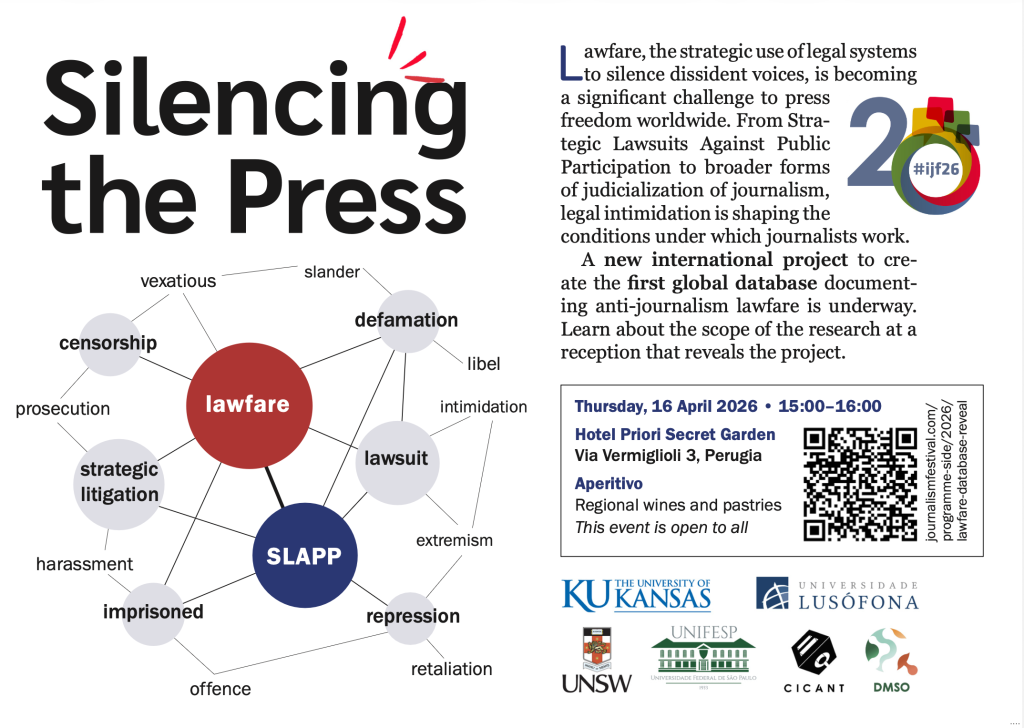
On 16 April 2026, researchers, journalists, and media scholars gathered in Perugia, Italy, during the 20th edition of the International Journalism Festival, for the event “Lawfare database reveal.” Held at the Hotel Priori Secret Garden, the session marked the public introduction of our project, the Lawfare Against Journalism, an international interdisciplinary research initiative, which is building the first systematic database of lawfare cases against journalists worldwide — bringing computational social science methods to bear on a problem that has, until now, resisted systematic study. The session brought together an international team of researchers leading the project: Lucia Mesquita (Lusófona University, Portugal), Mathias Felipe de Lima Santos (University of New South Wales, Australia), and Stephen Wolgast (University of Kansas, USA). Also, the session was joined by Charlie Holt, who leads the European work of Global Climate Legal Defense (CliDef), an organization set up to support climate activists facing SLAPPs and other legal threats Participants were introduced to the project’s scope and methodology, followed by an open discussion inviting attendees to share examples, insights, and potential collaborations. Organized by the School of Journalism at the University of Kansas, the session concluded with an informal networking session over refreshments, celebrating the project’s official launch and encouraging continued engagement from the global journalism community. The lawfare database project is currently in its initial phase and welcomes contributions from journalists, researchers, and organizations interested in documenting and combating the judicialization of journalism.
Lawfare Against Journalism project participates in SLAPP Resilience Roundtable in São Paulo
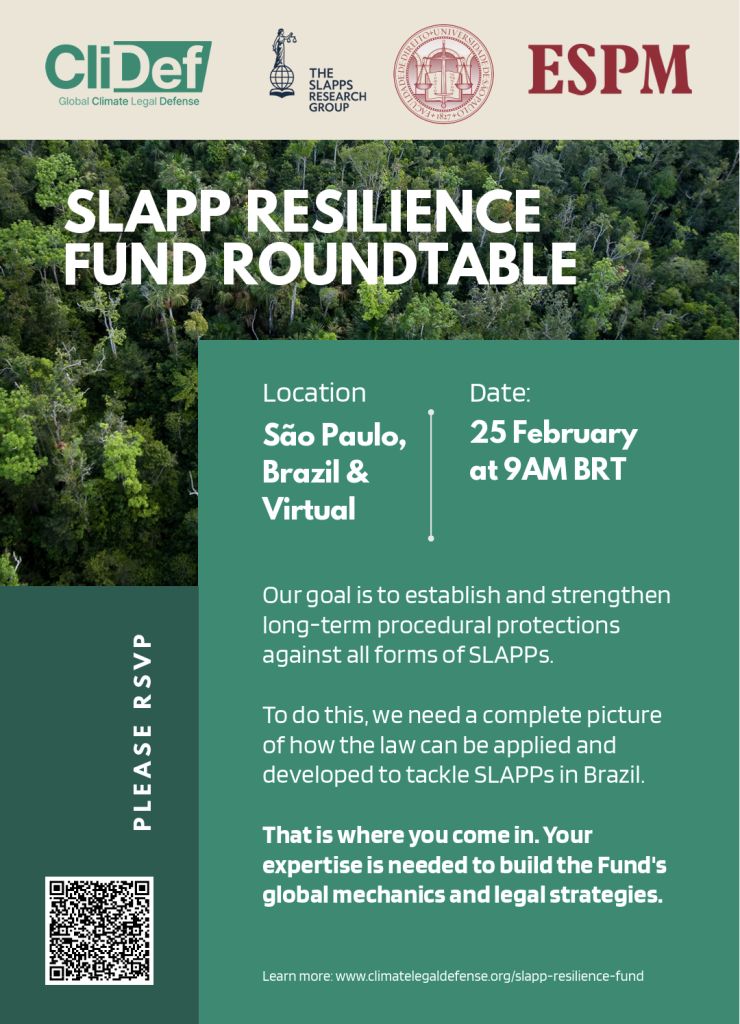
The Lawfare Against Journalism project took part in the SLAPP Resilience Roundtable, held on 25 February 2026 at the Escola Superior de Propaganda e Marketing (ESPM) in São Paulo, Brazil. Organized by Global Climate Legal Defense (CliDef), the roundtable brought together an international network of researchers, legal experts, and civil society actors to discuss strategic responses to Strategic Lawsuits Against Public Participation (SLAPPs). The event marked an important opportunity for the Lawfare Against Journalism project to engage with ongoing global efforts to address legal intimidation and its broader implications. Discussions focused on the development of the SLAPP Resilience Fund, a new initiative aimed at strengthening long-term procedural protections, supporting legal strategies, and fostering accountability in cases of abusive litigation. Throughout the day-long roundtable, participants contributed their expertise to map how SLAPPs and related legal mechanisms are shaping legal systems and impacting fundamental rights such as freedom of expression and assembly. The open and collaborative format encouraged in-depth exchange on legal strategies, comparative perspectives, and the need for coordinated international responses. The participation of the Lawfare Against Journalism project contributed to the growing importance of understanding SLAPPs within a broader framework of lawfare against journalists and media organizations. The discussions also highlighted the need for comprehensive data and cross-sector collaboration — key priorities aligned with the project’s ongoing work. This engagement represents a further step toward positioning the project within international networks addressing legal threats to public-interest actors, while contributing to the development of strategies to counter the growing use of lawfare worldwide.
Lawfare Against Journalism project presented at the Future of Journalism Conference
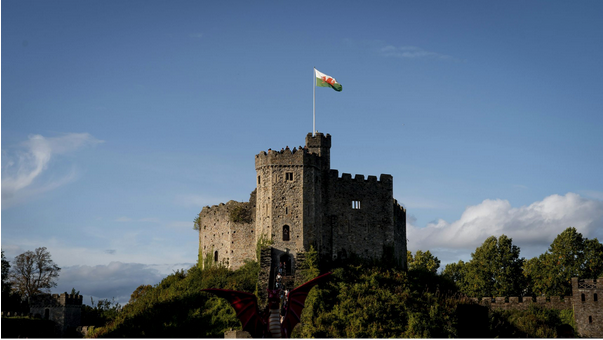
The Lawfare Against Journalism project was presented at the Future of Journalism Conference, held on 11–12 September 2025 at Cardiff University. The conference, hosted by the School of Journalism, Media and Culture (JOMEC), is one of the most established academic events in journalism studies in Europe, bringing together scholars from across the globe. Lucia Mesquita presented the study “Silencing the Press: Lawfare as a Tool Against Press Freedom,” marking the first academic presentation of the Lawfare Against Journalism project. The presentation introduced the project’s conceptual framework, which examines how legal systems are increasingly used to constrain journalism. Moving beyond a narrow focus on Strategic Lawsuits Against Public Participation (SLAPPs), the research advances the concept of systemic lawfare to capture a broader set of legal mechanisms — civil, criminal, and administrative — that are strategically mobilized to silence or deter journalistic work. The paper highlighted how these practices operate across different political contexts, from democratic to authoritarian settings, and contribute to what can be understood as a “judicialization of control.” By framing journalism as a form of social harm through legal narratives related to reputation, security, or morality, these mechanisms generate chilling effects that extend beyond individual cases. The presentation also outlined the project’s empirical approach, which combines media analysis, legal and policy document review, and interdisciplinary scholarship to map and understand the growing use of lawfare against journalists worldwide. This first academic presentation represents an important step in consolidating the project’s research agenda and engaging with the international scholarly community on the challenges facing press freedom today.