When the Law Becomes the Weapon: How Lawfare Is Silencing Journalism Worldwide
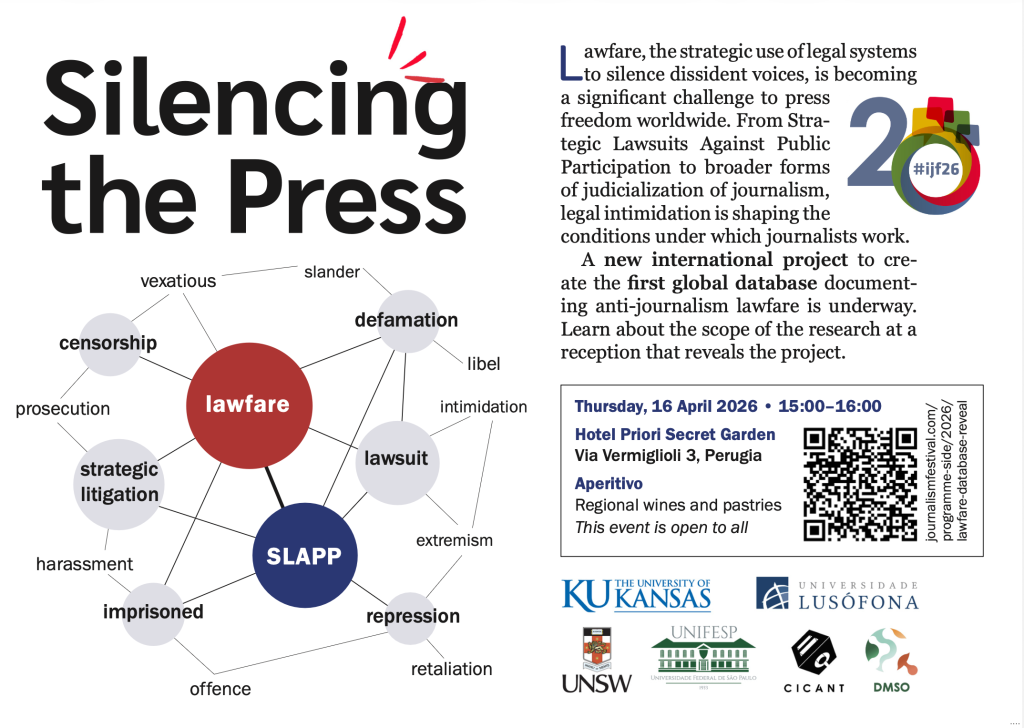
At the International Journalism Festival in Perugia this April, artificial intelligence consumed much of the air in many of the rooms during the event’s twentieth annual gathering. Yet, across the sessions focused on press safety, a different, less visible threat kept pushing its way into the conversation. One of the speakers, Maria Ressa, the Nobel Peace Prize laureate and co-founder of Philippine news outlet Rappler, gave it its sharpest name: “death by a thousand cuts.” She was not speaking metaphorically. She was describing five tax evasion cases, eleven arrest warrants in a little over a year, two arrests in six weeks, a company that could not open a bank account, $1.5 million spent on legal costs in a single year, and the experience of being questioned at Australian customs — on arrival and on departure — for offenses she has always denied. “I work-flowed it,” she said, with the weary precision of someone who has had to treat their own persecution as a project management problem. What Ressa was describing has a name in legal and advocacy circles: lawfare. And it is moving rapidly from those circles into the mainstream of journalism discourse. Beyond SLAPPs: what lawfare actually means Most journalists and press freedom advocates are now familiar with SLAPPs — Strategic Lawsuits Against Public Participation — the use of expensive litigation to silence critics and exhaust their resources. Awareness has grown to the point that the European Union adopted its Anti-SLAPP Directive in April 2024, and similar efforts are underway across national legislatures. But lawfare is a considerably broader problem — and a considerably harder one to see. While a SLAPP is a lawsuit, lawfare is a hidden strategy. It is the deliberate weaponization of legal systems, administrative frameworks, regulatory bodies, and bureaucratic processes to suppress dissent and silence journalism — not through overt censorship, but through the machinery of apparent legality. A criminal libel case is visible; a tax audit is not. A journalist jailed for their reporting makes headlines; a journalist whose media organization is denied a license renewal, or whose passport is quietly confiscated, or who faces a daily obligation to report to a police station, largely goes unnoticed. “The headline-grabbing tactics — jailing of journalists, assassination, attacks — are recognized,” said human rights lawyer Caoilfhionn Gallagher KC at the festival’s session on what she and her colleagues have taken to calling “lawfare light.” “But with ‘death by a thousand cuts’ — attritional efforts to prevent journalists from doing their jobs — the world looks away. And yet the end result is the same.” She shared examples ranging from Ethiopia, where journalists have found it mysteriously difficult to get licenses renewed ahead of elections, to Egypt, where travel bans and daily check-ins at police stations have become tools of control. More challenges include cases in Guatemala and Hong Kong, where clients of hers have been targeted not for their journalism but for alleged money laundering and fraud. “New ways of dressing up a whole lot of administrative, regulatory attacks as if they’re a bureaucratic issue, nothing to do with journalism,” as Gallagher put it. “Authorities have become more creative.” Four playbooks — and a spreading contagion What makes lawfare particularly dangerous is that its practitioners are learning from each other across borders and regimes. Gallagher, who sits on the board of the Committee to Protect Journalists (CPJ), identified four distinct playbooks at work in the session “Journalism and the law: standing together against rising intimidation“: The first is the discrediting playbook: target the journalist personally, not their work. If you can make a publisher-editor appear to be a tax evader or a fraudster, you undermine not only the individual but also everything they have reported. It is not coincidental, Gallagher noted, that the most prominent targets — Ressa, Jimmy Lai in Hong Kong, José Rubén Zamora in Guatemala — are publisher-editors. “Make people doubt both the messenger and the message.” The second is the ecosystem strangulation playbook: do not just target the journalist, target their support structure. Their lawyers. Their funding. In five years, as Ressa noted in her Nobel Prize speech, 22 journalists and 63 lawyers were killed in the Philippines. Foreign agent laws and foreign influence laws — spreading from Russia to Georgia and beyond — target the financial lifelines of independent media. The third is the immigration playbook: deny visas, impose travel bans, deport. These tactics, long associated with China and authoritarian regimes in Central Asia and the Middle East, are now, as Gallagher observed, being discussed in relation to the United States. The fourth is the legal pick-and-mix playbook: deploy multiple laws simultaneously across multiple jurisdictions, creating an overwhelming legal burden with no single clear press-freedom principle to contest. At the time of her murder in Malta, investigative journalist Daphne Caruana Galizia was facing 48 separate lawsuits. “People targeted with multiple laws at the same time,” Gallagher said. Gallagher also highlights in this final playbook the use of what she calls “false friends” — such as “fake news” laws — alongside the strategic deployment of multiple legal instruments simultaneously. This cumulative use of legal tools is not incidental. As research on journalism safety shows, particularly in contexts often considered secure, legal harassment rarely occurs in isolation. Instead, it tends to involve overlapping and repeated actions, including “multiple claims or threats” (Rožukalne et al., 2025, p. 12), reinforcing the systemic and strategic nature of these pressures. The geographic spread of these tactics matters. As Lucia Mesquita, the principal investigator of the Lawfare Against Journalism project, launched at the festival, argued: “Action which came from authoritarian regimes’ playbooks have now spread everywhere, especially in democracies. Something from the majority world is now being used to attack dissenting voices in democracies, including journalists.” This inversion of the usual frame — the Global South as the origin of a tactic now threatening northern democracies — is both intellectually important and politically uncomfortable. Is this just an authoritarian problem? The temptation is to think of lawfare